
Table of Contents
Voltage regulators are used for providing a stable supply voltage, free of noise and AC ripple, to power a circuit.
Different types include:
- Linear regulators: Starting with a higher than required input voltage, these provide a stable, lower output voltage. The regulator heats up as it dissipates the voltage drop times the current as heat. Low-dropout (LDO) versions can regulate their output voltage up to close to the input voltage, whereas regular ones require 2-3V headroom over and above the desired output voltage. Linear regulators are the lowest-cost types.
- Switching regulators: These use a PWM approach to rapidly 'chop' or 'buck' the input voltage, which after smoothing provides a lower output voltage. These don't warm up as much because there is essentially no voltage drop in the regulator; it is either on or off, not somewhere in between. Switching regs can be small (many are surface-mount) and provide relatively high current for their size, but they do require a few external components to function.
- DC/DC converters: This category includes step-up or 'boost' converters which can actually provide a higher output than the input voltage. These are similar in basic operation to the switching 'buck' converter just mentioned. Some are classified as buck-boost converters, meaning that they can provide an output of 5V (say) from an input of anywhere from 3V to 9V. Pretty handy stuff.
Linear regulators
78xx, 79xx
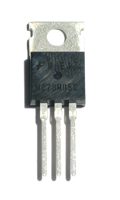
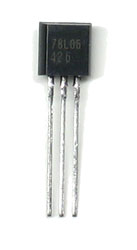
The simplest and best known regulators are the 78xx and 79xx series, where xx is the desired output voltage. They have three pins: input, output and ground. 7805 will get you 5V on the output pin, as long as you supply an input voltage of at least 2-3V more. 79xx Series are for negative output voltages, but they work the same. These "building blocks" are great for making a simple and stable power supply.
Important: always place a 100nF capacitor between the output pin and the ground pin. Otherwise the regulator could start oscillating.
- Pinout: Input - Ground - Output. Tab is connected to ground
- Output voltages 7805 → 5V, 7806 → 6V, 7809 → 9V, 7812 → 12V, 7815 → 15V
- Dropout: ~2V
- Input voltage: at least 3V higher than output voltages, max 17V to 30V.
- Current: max 1A (assuming that the power dissipation isnt too high for the package)
Variants:
- 78Lxx, 79Lxx: (the middle character is an 'L') max 100mA
- 78Mxx, 79Mxx: max 500mA
- 78Sxx, 79Sxx: max 2A
The following table has links for 7805 only, since those are the most popular!
LM2931-XX series
The LM2931T (TO-220 high current) and LM2931Z (TO-92 low current) LDOs are 78XX pin-compatible, and available in 5V, 3.3V, or adjustable voltages. Much lower drop-out voltage than 7805, much higher input voltage limit, with built-in battery reversal protection and over-voltage protection. Nice when you want an 78xx upgrade!
| Image | Part # & Datasheet | Description | Package notes | Distributor |
|---|---|---|---|---|
 | LM2931 | . | Packaged in SOP-8, TO-92 or TO-220. | Widely avaiable from many suppliers and manufacturers. |
'1117-XX series
The 1117 series regulators are similar to the 7805 series, but have a lower dropout. The pinout is NOT the same, they are NOT drop-in replaceable!
- Output voltages: 1117-1.5→ 1.5v, 1117→1.8 → 1.8V, 1117-3.3 → 3.3v, 1117→5.0 → 5.0v, 1117 → adjustable!
- Dropout: ~1.0 V
- Input voltage: 1V above output voltage, up to 15V
- Current: 800mA (assuming that the power dissipation isnt too high for the package)
The following table has links for the 1117-3.3 and 5.0 only, since those are the most popular. 1117 Datasheet
LM317, LM337
Basically the same as the 78xx regulator, but adjustable. It also has three pins: input, output, adjust. A voltage divider (2 resistors) is connected to the output pin and ground to create a reference voltage. This reference voltage is connected to the adjust pin. The regulator will adjust the output voltage, until the reference voltage is 1.25V. By altering one of the resistors of the voltage divider, you can adjust the output voltage.
- Output voltage: min 1.5V, max 37V
- Input voltage: ???
- Current: max 1.5A
- Variants: LM350 - max 3A, LM338 - max 5A
Others
| Image | Package | Part # | Vout @ Iout | Distributors | Eagle library part |
|---|---|---|---|---|---|
 | TO-92 | MCP1700-330 | 3.3V @ 250mA The highest current output we could find in a TO-92 pkg | Mouser | adafruit:MCP1700 |
Switching regulators
7660 Switched Capacitor Voltage Converter
The 7660 is a voltage converter capable of converting a positive voltage in the range of +1.5V to +10V to a negative voltage of −1.5V to −10V
| Image | Part # & Datasheet | Description | Package notes | Distributor |
|---|---|---|---|---|
| . | LCM7660 | Charge pump based step-up/voltage inverting chip. Provides a low-current voltage at either -Vin or 2Vin, using only capacitors. Suitable for providing a negative rail for low-power op-amp circuits, or a low-current stepped-up supply for programming voltages on flash-based microcontrollers. | Available in MSOP-8, PDIP-8, SOP-8. | Widely available from many suppliers and manufacturers. |
DC/DC converters
| Image | Package | Part # | Distributors | Eagle library part |
|---|---|---|---|---|
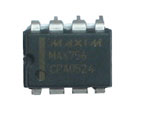 | MAX756-CPA | DC/DC Boost 3.3V or 5V or adj out | Digikey Mouser Maxim Direct | adafruit:MAX756 |
| " | LT1302(CN8-5) | DC/DC boost In 3V, 5V or adjustable | Newark Linear Direct | adafruit:LT1302 |


